

No products in the cart.
For over 50 years of experience at POOL&SPA in designing and maintaining pools, we’ve seen many clients make common mistakes when selecting equipment. Some choose only the cheapest option, while others buy a popular brand without considering if it’s right for their pool. These decisions inevitably lead to problems down the line. Thus, we gather 5 essential tips to help you choose the right pool equipment, saving you time and money in the long run.
1. Match the Equipment to Your Pool Size and Actual Usage—Not Just the Price
The most common mistake is choosing equipment that is too small or too large. Your pump and filter must be correctly sized for the water volume. If they’re too small, they won’t filter fast enough, and your water will be dirty. If they’re too large, you’re unnecessarily wasting electricity and money.
A 50-cubic-meter pool needs a pump and filter that can circulate the entire volume of water within six to eight hours. If you buy a smaller, cheaper pump that can only circulate half the pool per day, the water won’t be clean. You’ll have to use more chemicals, and ultimately, you’ll spend more money.
Besides the pool size, you must consider usage. A residential pool used by a few people needs different equipment than a resort pool used by dozens daily. An outdoor pool exposed to strong sunlight requires a different system than an indoor pool.
Our Advice: Have an expert calculate the appropriate equipment size for you. Don’t guess. Don’t try to save money here, because a mistake will cost you money and headaches throughout the life of your pool.
2. Choose Quality Over the Lowest Price
We understand everyone wants to save money, but buying the cheapest equipment is often a false economy. Cheap equipment is rarely durable; it breaks down often, requires frequent repairs and replacements, and you end up spending more than you would have on good quality products from the start.
A high-quality pump might cost a few hundred dollars more than a cheap one, but it can run for ten years or more without issues. A cheap pump might fail within three or four years, requiring repairs or a full replacement. The cumulative cost is higher, not to mention the stress of breakdowns and having dirty water while the pump is out of service.
The same goes for filters. A good filter is efficient, durable, and lasts a long time. A cheap filter may not strain well, leak, or break, requiring frequent replacement.
Automatic chemical controllers are also crucial. If you choose a cheap one, the readings may be inaccurate, operation may be inconsistent, and chemical levels will be incorrect, leading to unclean water.
Our Advice: Choose established brands with a good warranty and a reliable service center in your country. Ensure spare parts are easy to find. Avoid very cheap, unknown brands with no warranty; when they break, you may not find parts and have to buy an entirely new unit.
3. Choose Energy-Efficient Equipment
Electricity is a recurring expense for the entire lifespan of your pool. A power-hungry pump might be cheaper to buy, but in the long term, it will cost you far more in electricity than an energy-efficient one.
Variable Speed Pumps can save 50-70% on electricity compared to older models. While they may cost one to two thousand dollars more upfront, the savings in electricity will provide a return on investment within two to three years. After that, it’s pure savings for the next decade or more.
If you need a heater, choose a Heat Pump, which is significantly more energy-efficient than a direct electric heater. The unit price may be higher, but the running cost is many times lower.
For underwater lighting, switch to LEDs. They consume less power and have a much longer lifespan than traditional bulbs. The initial cost is higher, but they use less electricity and don’t need frequent replacement.
4. Choose Easy-to-Maintain Equipment
Some equipment may be highly efficient but complex and difficult to maintain, often requiring specialized knowledge. If you lack the time or expertise, this equipment will become a burden.
Sand filters are generally easier to manage than DE filters, especially if you lack experience. Regular backwashing is all that is typically needed, without the hassle of adding DE powder. Cartridge filters are also simple to maintain—just remove and rinse with a hose—but you need to purchase new cartridges periodically. If the brand is hard to find, maintenance becomes difficult.
Sand filters are generally easier to manage than DE filters, especially if you lack experience. Regular backwashing is all that is typically needed, without the hassle of adding DE powder.
Pumps should be easy to maintain. Choose a model where the strainer basket lid is easy to open and clean. If it’s difficult or requires special tools, you might procrastinate on cleaning, allowing the basket to fill and reducing pump efficiency.
Our Advice: Select equipment that is easy to maintain, fitting your knowledge and available time. If you’re unsure about self-maintenance, plan to hire a professional pool service regularly. Avoid overly complex equipment.
5. Check for Available Spare Parts and After-Sales Service in Thailand
This is the point many people overlook. Some brands look great and are well-priced, but they are direct imports with no local representative. When they break down, finding spare parts is impossible, or you have to order them from abroad, waiting months and incurring high shipping costs.
Some brands have local representatives, but the service is poor: they are hard to contact, don’t return calls, or have long wait times for technicians. When your pool breaks down, no one is available to help.
Our Advice: Before purchasing, check if the brand has a local representative or service center. Ask about spare parts availability, price, and the quality of their after-sales service.
Try calling the service center. Test their responsiveness, helpfulness, and knowledge. If they are hard to reach for a sales query, imagine the difficulty when your machine is broken. Read online reviews to see if customers complain about the service, response time, and problem-solving ability.
Good after-sales service provides peace of mind. When problems occur, you have support. Excellent equipment is useless without reliable service.

Summary
Choosing swimming pool equipment is not easy, but if you remember these 5 tips, you will make the right decision: Choose based on size and usage, select quality over cheap prices, invest in energy efficiency, pick easy-to-maintain systems, and verify local spare parts and service.
Investing in good equipment from the start is highly cost-effective in the long term. You’ll have clean water, lower running costs, fewer headaches, and truly enjoy your pool.
TIPS

Single Speed vs Variable Speed Pump: Choosing the Right Swimming Pool Pump
Should your pool run on a single speed pump or a variable speed / inverter pump? This guide breaks down how each type works, why lower speeds can cut energy use, and the key questions to weigh before deciding — with expert guidance from POOL&SPA Thailand.
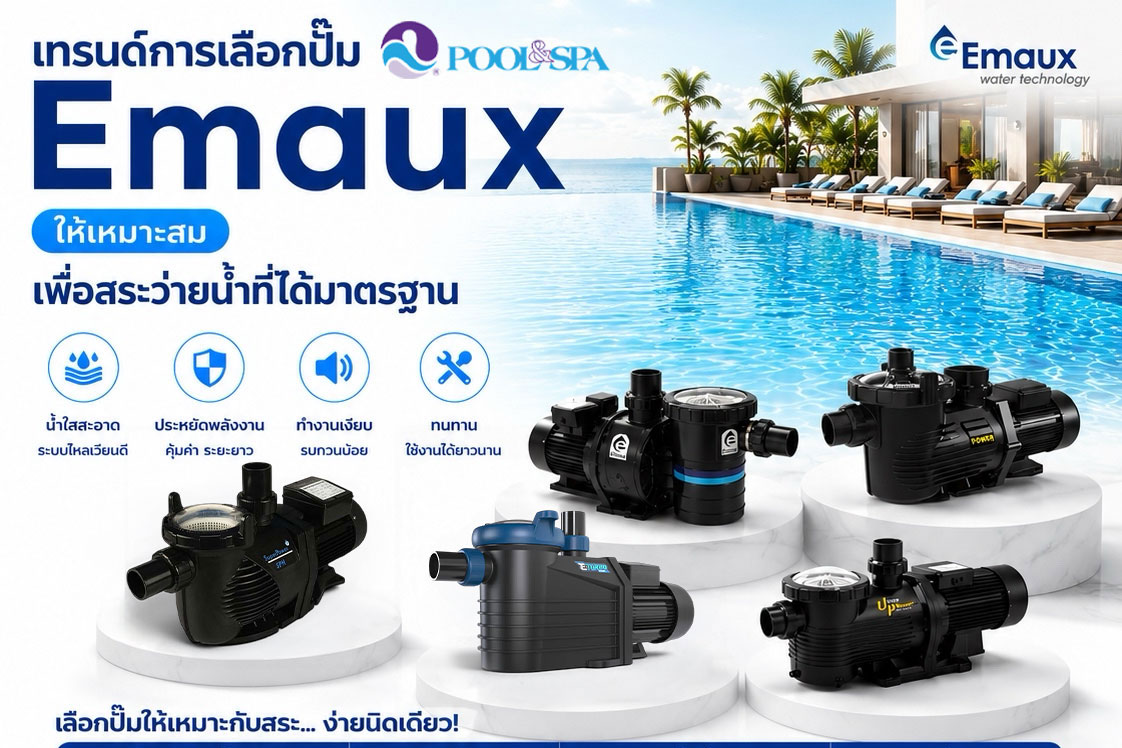
The Definitive Guide To Choosing Your Emaux Pool Pump
Learn how to choose the right Emaux pump for your home, hotel, resort, and commercial pool. In this guide, we’ve compiled a comparison of models, their advantages, applications, and expert advice from POOL&SPA Thailand, all to make your decision easier.

Easy-to-Maintain Pool Design: A Beautiful Pool That Lasts, Stays Clean, and Saves More in the Long Run
Having a private swimming pool at home has become a popular lifestyle choice among modern homeowners, as it provides an additional space for relaxation, promotes good health, and enhances the value of the property. However, what many homeowners often discover after building a pool is the burden of its upkeep—including issues such as green water, algae buildup, the cost of chemicals, and the significant amount of time required for cleaning.